Reaction to physical assault

Preventing robot bullying | Atomic

Find similiar patterns:

Preamble

Type

Atomic Pattern; preventing robot bullying

Ranking

** (initially validated through empirical user studies)

Version

1

Author

Selina Layer (selina.layer@iao.fraunhofer.de), Kathrin Pollmann (kathrin.pollmann@iao.fraunhofer.de)

Design Challenge

Interaction Situation

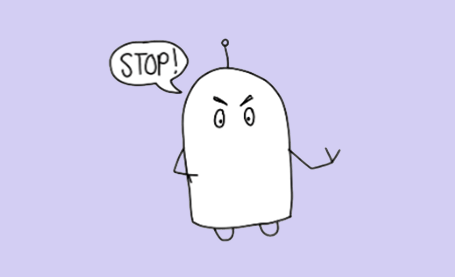
During human-robot interaction, situations can arise where the user assaults the robot out of frustration or anger, e.g. by kicking or hitting it. This is particularly the case when robots operate unsupervised in public spaces. If a user commits physical assault against the robot, it should attempt to stop current and future assaults to prevent further damage. The urgency to intervene and stop this behavior can be considered as high.

Communication
Goal

“Do not assault me again.”

Design Solution

Solution

The robot’s reaction to physical assault should be a direct and clear text message, communicated via speech or written text on a display. Three versions of text messages are proposed. Both versions showed a similar effectiveness although the reasons for this might be very different. One version should be selected based on the use case and goal at hand: A) Informative message: “Vandalism can have legal consequences”. The robot informs passers-by about the fact that bullying behavior has legal consequences. This message makes the robot appear mostly like a tool not causing empathy for the robot and therefore shifting the focus on possible personal consequences. B) Feeling message: “I don’t like being damaged.” The robot shows an emotional reaction phrased from its own point of view. This message makes the robot appear a lot more humanlike and less like a tool. Accordingly it might specifically be working for people with a higher empathy or sensitivity.

Rationale

When humans want others to stop certain behavior that impacts them negatively they often get emotional by raising their voice, shouting or crying. Dependent of the situation and personality for more empathetic people this can lead to a quick interruption of the unpleasant behavior because the empathetic person at this moments realizes the discomfort of the other person. This is why humanizing objects such as robots can be helpful to prevent bullying behavior. Additionally people usually fear legal consequences which sometimes prevents criminal behavior for self-protection reasons, independent of personality factors such as empathy.

References and
Context