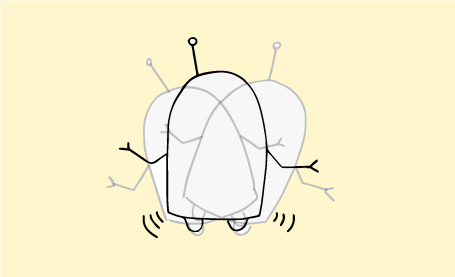
Let the robot make small movements with single joints (e.g. arms, head or facial parts) or with the whole body. These movements can be idle / random but should – if possible – be meaningful and match the interaction context. Depending on the robot’s form and capabilities, suitable idle movements can be the imitation of breathing through sinusoidal body motion, posture sway from left to right, shifting the robot’s gaze away from the user from time to time or adding random blinks to the robot’s eyes. If a robot uses face tracking, the impression of liveliness is automatically supported by the robot’s head shifts towards the user. In general, movements should not be to abrupt and fast, in order to not attract to much attention during the interaction.
Creating certain idle movements to express vividness is often used as a stylistic device for character animation in video games. This idea is inspired by human behavior: The human body never remains completely still; it is always somehow in motion. Principles of character animation like breathing, blinking, gaze and posture shifts have been successfully applied to robot behavior design and shown to be effective in creating an illusion of vividness. Depending on the robot, idle movements can be realized as movements on the floor or movements of different body parts such as head, arms or torso. For robots with faces, small movements can also be realized with different facial parts. For animated eyes, blinking is often used as a sign of vividness, as can be seen in the movies Baymax and Wall-E or the autonomous life mode of Softbank’s Pepper robot. References and further reading: Cuijpers & Knops, 2015; Egges, Molet, & Magnenat-Thalmann, 2004; Löffler et al., 2018; Mizoguchi et al., 1997; Ribeiro & Paiva, 2012