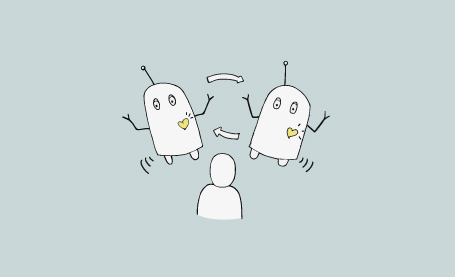
Let the robot express that:
It directs its attention towards the user using a user-oriented positioning in the room, letting robot and user face each other. (Attentive). It wants the user to pay attention to what is happening next (Demanding attention). Its operation mode is , setting the status light to permanently glowing (Operation mode on). Although the user is a passive listener, the robot needs to keep them engaged in the interaction, especially if the monologue exceeds 20 seconds. This can be achieved by letting the robot express: That it is alive through idle movements of body, facial parts or on the floor. (Lively)
Explaining something means that the user’s attention needs to be focused on the robot for a longer period of time, which requires two sub-actions: facing the interaction partner to signal that your attention is focused on them and being able to keep the attention during the whole time. Explaining naturally includes verbal output of the robot, which is attention grabbing by itself. If applicable, the demand for attention can be emphasized by an expression of vividness. From attention research, it is known that movements attract attention. Thus, idle movements on the spot or of body and facial parts can be used to maintain user attention on the robot. Further details about the described sub-actions can be found in the descriptions of the Atomic Patterns “Attentive”, “Demanding attention” and “Lively”.