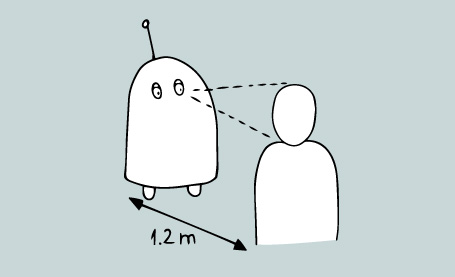
ttentiveness towards the user can be expressed with a useroriented positioning in the room. Position the robot in social distance from the user (~1.2 m) and let the front of the robot face the user. It should always be clear, where the frontal part of the robot is. If possible, use active user tracking to let the robot maintain eye contact with the user. Eye contact can also be achieved with robots that do not have eyes: in this case the visual sensory organ, the camera, should be pointed at the user and (if possible) follow their head based on user tracking.
In the interaction between different agents, attentiveness can be signaled through coming closer, decreasing the distance between oneself and the other agent. Research in human-robot interaction shows that a robot is perceived as attentive, when its front is facing the user. From social interaction, we have also learned to interpret eye contact as a sign that someone’s attention is on us. Establishing eye contact is used as an unvoiced agreement to engage in social interaction with each other. These two concepts can easily be transferred to robots, as demonstrated by two examples: In the movie “Robot and Frank” the robot turns towards the user when talking to him. Pixar’s robot Wall-E moves its head closer to objects of interest. References & further reading: Goffman (2008), Jan and Traum (2007), Cassell and Thorisson (1999), Cassell et al. (1999), Mizoguchi, Takagi, Hatamura, Nakao, and Sato (1997)
needed by Active, Becoming active, Becoming inactive, Processing, Not understanding, Showing, Listening, Explaining, Encouraging good performance, Joyful positive feedback, Displeased Positive feedback, Empathic negative feedback, Gloating negative feedback is opposed to Inside turn, Passively available