
Preventing Exploration
Preventing robot bullying | Atomic
Find similiar patterns:

Preamble
Type
Atomic Pattern; preventing robot bullying
Ranking
** (initially validated through empirical user studies)
Version
1
Author
Selina Layer (selina.layer@iao.fraunhofer.de), Kathrin Pollmann (kathrin.pollmann@iao.fraunhofer.de)
Design Challenge
Interaction Situation
When an autonomous robot is encountered in a public space for the first time, people may engage in exploratory behavior e.g. through approaching the robot, touchi capable of doing. Such moments of exploration are typically subtle and spontaneous, yet they can still disrupt the robot’s task. The robot should actively prevent this critical situation to ensure that it can operate effectively and safe. Anyway the urgency of interrupting this behavior is not high, why a rather subtle way of communication should be sufficient in order not to disturb passers-by to often.
Communication
Goal
“Do not harm me or disturb my work.”
Design Solution
Solution
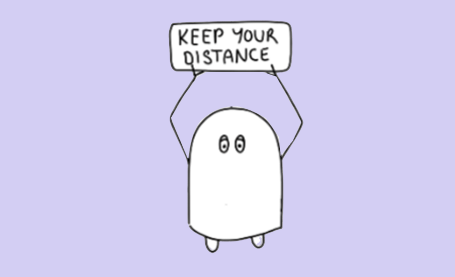
A preventive measure to minimize the occurrence of explorative and bullying behavior of passers-by is to place adhesive signs on the robot with messages that discourage bullying behavior. Adhesive signs are low cost, unobtrusive and can be perceived in passing. Three versions of signs are proposed. One version should be selected based on the use case and goal at hand: A) Informative sign: “I am under surveillance”. The robot informs passers-by about the fact that it is operated under surveillance, alluding to the fact that, if detected, bullying behavior has legal consequences. This sign is best suited if passers-by should perceive the message in passing with minimal cognitive processing effort. If the area the robot is operating in is under video surveillance, it is recommended to replace the eye icon of the illustration below with a camera. If there is no video surveillance or surveillance at all, pretending there would be one, by using a camera icon and/or the slogan “I am under surveillance”, might be forbidden dependent of the countries law. B) Prompting sign: “Please keep your distance. I am working!” The robot proactively instructs passers-by to keep their distance and not disturb its work. The instruction is phrased as a friendly imperative. It is most effective in keeping people away from the robot, while requiring a medium level of cognitive processing and being perceived as visually pleasant. C) Feeling sign: The robot shows an emotional reaction phrased from the robot’s point of view. People prefer the design of this sign over the other two. It requires more cognitive processes, which makes it best suited if you want people to engage deeper and longer with the sign and its message. It should be used when you want the robot to be perceived more human-like and as a social agent rather than an autonomous machine and if you want to promote empathy towards the robot. You should note that this focus on an emotional connection between passers-by and robot may, at times, urge people to approach the robot (rather than keeping their distance).
Rationale
Signs are a very common and subtle way of informing people to keep distance or not to disturb certain areas or objects. They often can be found in everyday life, e.g. at construction sights using hand illustrations to inform people in a subtle way to keep distance, or e.g. on public and even private property (surveillance) using camera icons to inform about video surveillance. Usually these are combined with an explanatory sentence on the sign. Those signs being so common for humans significates quick recognition and understanding without interrupting their current doing.
References and
Context