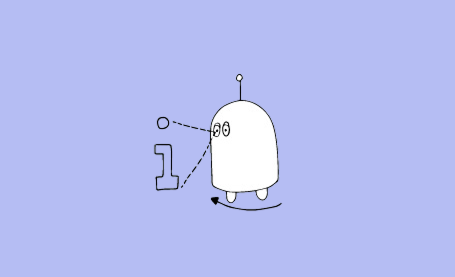
The robot can evoke joint attention through its own behavior. The user’s attention can by guided by directing the robot’s gaze at the object or information. Another way is to shift the robot’s body posture so that it faces the information. Alternatively, the robot can make a defined pointing gesture towards the information. As shown in social human interaction, the user will follow the attention shift of the robot and direct their own attention at the information.
Whether on the screen, in virtual reality or in real life – moving objects attract attention. The observer’s attention follows the movement and is thus directed to both, the moving object and its target. Robots can use movement to guide the user’s attention. This impression can be further emphasized by making use of the phenomenon of joint attention: In human-human interaction, we tend to follow the gaze of the other person when it moves away from our face. The same principle is used by animals such as cats to communicate with their owner. Studies have shown that robots with eyes can achieve similar joint attention effects, when directing their gaze at relevant information during a joint robot-user task. Another way to explicitly guide another person’s attention is to point an arm, hand or finger at the object of interest. Such pointing gestures are very familiar to us from daily interactions with other humans, and also often used by robots with arms in different science fiction movies. References and further reading: Clair, Mead, & Matarić, 2011; Mizoguchi et al., 1997; Mutlu, 2009; Salem, Eyssel, Rohlfing, Kopp, & Joublin, 2011